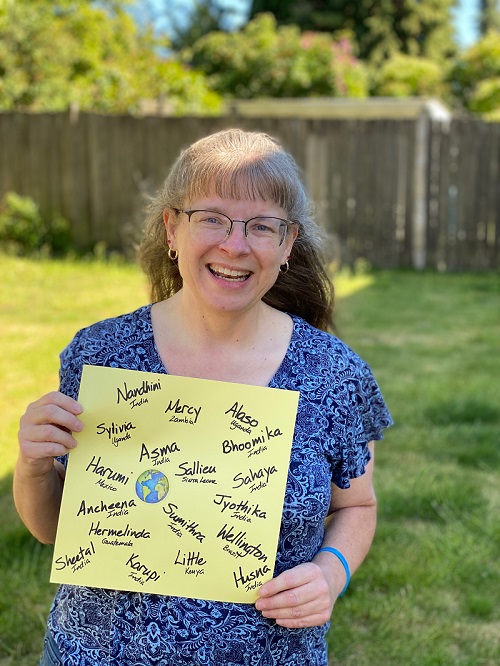
Angie of Seattle, Washington, has sponsored 18 children over the
course of her 35 years with ChildFund.
Picture this: The year is 1985. Most teenagers are spending their pocket money on Guess jeans, hairspray
and date nights at the movies. But Angie isn’t like most teenagers. All she can think about is
how on earth she’s going to earn the $18 a month it costs to sponsor a
child.
Thirty-five years later, Angie laughs at how creative she had to get to make it happen. “I convinced my
bell choir,” she says. “I had always thought child sponsorship seemed like a good idea because I loved
the idea of connection with people.”
Each of the choir members threw in $20 to sponsor Asma, a 4-year-old girl in India, for one year. The
amount covered the monthly sponsorship fee, plus a little extra for Asma’s birthday and the holidays.
But after a year, Angie had to move out of town – and the bell choir decided to cancel the sponsorship,
choosing to save money for a trip to London instead. Angie was heartbroken.
That was the moment when, at 17, this fiercely compassionate sponsor decided it was up to her to continue
the journey with ChildFund on her own. If you can afford to make a difference in a child’s life, she
thought – to become a mentor and true friend to someone who could really use the support – why would you
miss the opportunity?
To India and beyond
In college, Angie
worked a part-time job that brought in enough income for her to sponsor a child herself:
Wellington, a 3-year-old boy in Brazil. “Then, when I got a ‘job’ job after I left college, I
said, ‘You know what … I wonder if I could sponsor Asma again too.’”
It seemed like
a long shot, but Angie called the ChildFund office and explained the situation. As it turned
out, Asma, now 11, was indeed available for sponsorship again. Angie got to pick up right
where she left off; she devoted herself to getting to know Asma more deeply, exchanging
letters and photos, sending gifts. And just three years later, she got the opportunity to
fly to India and meet Asma in person.
Angie spent two
and a half weeks visiting five different projects throughout India, including a visit to
Bangalore, where Asma lived. The experience was the first of many international trips for
Angie, and it turned her perspective on life upside-down.
“I came home
from that trip, and I couldn’t sleep for a week before I decided I was going back to India,”
she says.
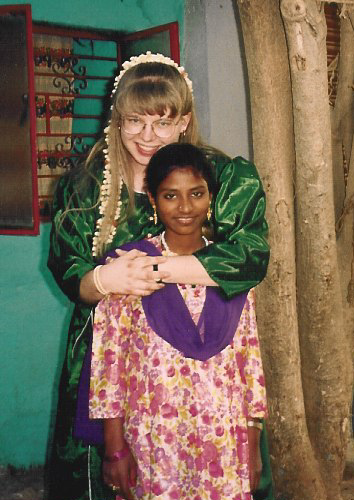
Angie and
Asma, 1996.
Angie has since
visited various ChildFund projects in India, Thailand, Mexico and the United States,
creating three decades of memories with her many sponsored children all over the world,
especially in India.
Like the two times she brought her
daughter, Asha, along with her to India to meet her sponsored kids.
Or the time she took her mother’s
sponsored child, 10-year-old Sangeeta, and several of her friends on a day trip to the Taj
Mahal. “I had been on a tour of the Taj Mahal myself before, but never with five
10-year-olds,” Angie laughs. “Seeing anything through 10-year-old eyes is great, but seeing
the Taj Mahal … it was pretty awesome.”
But being a sponsor isn’t just about
going on adventures, learning about different cultures and having new experiences. For
Angie, it really is all about the kids.
“One of the greatest strengths of
the sponsorship model is the personal connection,” Angie says. “It’s the kids getting that
somebody cares about them enough to pay money for them every month, write them a letter
every once in a while, send them gifts, those kinds of things. You’re helping kids
understand that they have a village loving on them.
“When we’re paying for sponsorship,
we’re not only loving them, but their project staff is connecting with them and giving love
and support to them. And the understanding that this village may be global is going to make
a big difference in their capacity for taking care of themselves and helping other people in
adulthood.”A hands-on approach to sponsorship
There’s no wrong
way to be a sponsor, after all. Some people simply provide their monthly donation and trust the
organization to do good work in their sponsored child’s life. Some are great gift-givers; others
are good at writing letters consistently.
It’s hard to
try to do it all on top of all the other responsibilities we have in life. But if you ask
Angie, there’s something to be said for taking the most hands-on approach possible – for
taking advantage of every opportunity available to you as a sponsor to connect with your
sponsored child.
“I’ve always
been a major proponent of letter writing. In my experience, letters are a huge deal for the
kids. I’ve heard that from kids at every project I’ve visited,” she says. “There are periods
in which I don’t write for a while, and I feel guilty about that. But feeling guilty doesn’t
get a letter written. So, I’ll just start writing a letter, ask the kids for forgiveness and
recommit to consistency. I’ve found it helps to track when I’ve sent letters on a chart or
on my calendar.
“Kids don’t know how much we care
about them and how often we think about them unless we tell them. If you can’t write often,
tell them in a letter about how you’ve been thinking about them in your daily life, and the
things that remind you of them. Remind them in each letter how special they are to you and
why.”
One thing Angie likes to do is
create information sheets full of questions that she fills out, then sends along to her
sponsored children for them to fill out as well. The questions cover everything from school
to weather to likes and dislikes and give her a clearer perspective on things they may have
in common. She prints copies of all the letters she sends and receives, then keeps them in
separate files for each of her sponsored children to stay organized. For Angie, the process
of getting to know her sponsored children, and asking them about their specific needs, is
serious business.
“I ask, is there anything I can help you buy
that will help improve your life? If it’s very expensive, I won’t be able to do it right
away, but I can try.” For instance, after three years of saving, she was recently able
to send money to help her sponsored child Nandhini’s family rebuild their house. It had
been severely damaged in the 2004 Indian Ocean tsunami, and when Angie and Asha saw it during a visit
to India, they knew they had to help repair it.
Angie says she also tries to be
sensitive to how children’s needs have changed and become more urgent in light of the
global COVID-19 crisis. She recently decided to sponsor
a child in Sierra
Leone after hearing a story on the radio about
kids there being at higher risk for child labor during the pandemic.
“Sponsorship isn’t earth-shattering
for every single kid, but for some, it really is,” Angie says. She remembers when
Wellington, the child she had been sponsoring in Brazil since he was 3, suddenly lost his
mom. She was able to grieve with him and continue to be a source of ongoing support. “It
just felt so nice to have been a constant in his life since he was so little,” she says. “He
knew for sure that he had a sponsor who cared about him, and I think that’s really
meaningful for kids.
“When I sponsor a child, I know that
somewhere in the world, there is a child who is guaranteed education, medical care,
emergency care, emotional support. And there’s nothing more powerful than that. I can do
that for a child.”