Site will be
unavailable for maintenance from June. 4, 11:30 p.m., to June 5, 12:30 a.m. ET. Thank you for your
patience!

Spowdi and ChildFund partner to advance smart farming among small-hold farmers
Posted on 08/15/2024
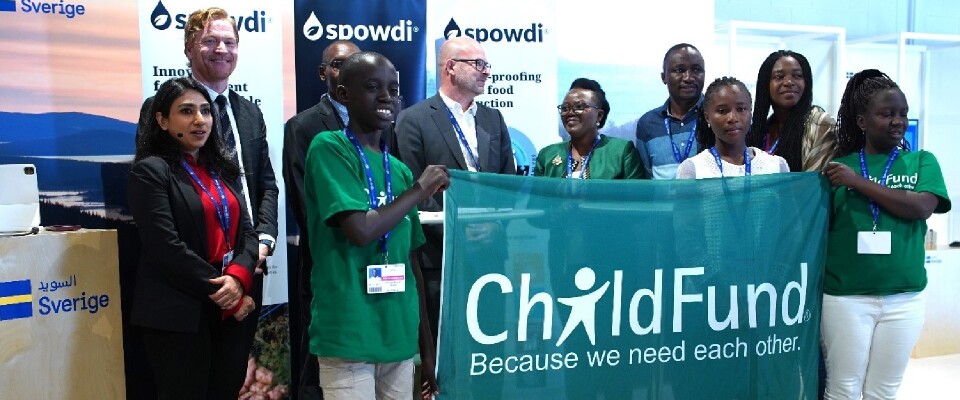
ChildFund and greentech innovator Spowdi have joined forces to promote sustainable smart farming among small-hold farmers in Kenya. The two organizations signed a three-year agreement at COP28 to introduce smart farming technologies to tens of thousands of small-hold farmers to enhance food production while using minimal water resources.
This initiative will kick off with the implementation of a pilot project supporting 250 small-hold farmers in Migori and Nyeri counties in Kenya and later scaled to reach 10,000 farmers within the country over the next three years. Upon completion of this first phase, this initiative will be replicated in other countries in Africa (Uganda, Ethiopia, Zambia, Mozambique, Guinea, Senegal, Sierra Leone and The Gambia).
Through this partnership, farmers will receive equipment and onsite training on how to use smart irrigation technology, including Spowdi’s solar-powered, mobile, water distribution systems “Spowdi Mobile Pro Mk2,” which will also be used for training in micro-irrigation techniques. Spowdi and ChildFund will also establish demonstration sites, testbeds and training hubs for farmers, trainers, distributors, educationists and other partners.
“Small-scale farmers are the backbone of our food production systems,” said Chege Ngugi, ChildFund International Africa Regional Director. “Unfortunately, they, just like many other entities, have borne the brunt of global temperature rise. This partnership could not have come at a better time, when many communities are reeling from frequent droughts. By adopting Spowdi’s award-winning technology, our farmers will be able to grow more food using less water. This way families will have enough for their consumption and surplus for sale, as they work to build resilient livelihoods.”
“With Spowdi’s smart farming app, the impact generated by each small-hold farmer can be mapped and measured, contributing to valuable data on resilient food systems,” says Henrik Johansoon, Spowdi’s CEO. “The gap lies in enabling farmers to adopt the technology, for which we urge finance stakeholders to play their part and provide farmers the ‘kick-start financing’ needed to become the Impact Generators we all depend on.”
“Now it’s time for action,” says Henrik Johansoon, Spowdi’s CEO. “Spowdi’s technology last-mile distribution has proven to generate 300% more food [while using] up to 80% less water, resulting in higher profitability and better livelihoods. The technology and last-mile distribution help small-hold farmers to move away from fossil fuels and reduce the time spent in the field, which can then be used for other socio-economic activities. Importantly, it also empowers communities to be food self-sufficient.”
Overall, this project aims to promote food security, economic empowerment and environmental sustainability. The initiative will also tackle the issue of malnutrition that has impeded the growth and development of many children in rural sub-Saharan Africa.
Loading...
