Site will be
unavailable for maintenance from June. 4, 11:30 p.m., to June 5, 12:30 a.m. ET. Thank you for your
patience!

Creating a Safety Net for Children: Sri Lanka
Posted on 11/18/2005
By Kirsten Hongisto, communications manager-Asia for Christian Children's Fund
In many ways the children had the most to lose when the waves came crashing through their homes and schools. Now, many months after the waves struck, they require further assistance to prevent terrible problems associated with displacement — disease, hunger, malnutrition and exploitation — in the aftermath of such a disaster.
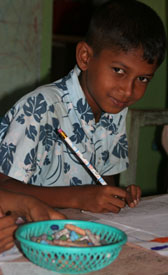 |
| A child draws while attending a Child Centered Space in Hambantota. |
The statistics give rise for concern about the children’s vulnerability. More than 1,400 children lost one or both of their parents in the southern coastal areas of Sri Lanka, including Galle, Hambantota and Matara.
The majority of these children, more than 760, live in the district of Hambantota.
Approximately 1,100 children lost one parent in the family, often the mother. These children are now living with their fathers, who must act as primary caregiver perhaps for the first time.
Children directly affected by the tsunami, especially those who lost one or both parents, are a priority interest for Christian Children's Fund-Sri Lanka. CCF-Sri Lanka met with both UNICEF and government administrators and came to an agreement: children directly impacted by the tsunami should not end up in orphanages.
CCF worked to strengthen the ability of family and community members to care for the children. In addition, CCF increased the effectiveness of government agencies mandated with ensuring children's interests.
Because of these CCF aims and other related initiatives, few children were sent to orphanages.
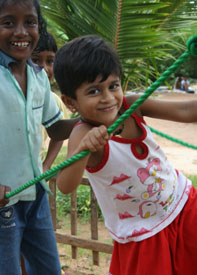 |
| Child Centered Space activities at the Wellingama Temple in Matara always include a bit of fun on the rope bridge. |
Supporting the Caregivers
Recognizing the need to help strengthen the social work system in Sri Lanka, CCF-Sri Lanka and UNICEF launched a child protection pilot project in June 2005. It is designed to create a safety net for children.
Upon completion of the two-year project in Hambantota, Matara and Galle districts, an effective social services system — with training, supervision, monitoring and evaluation — should be in place.
The pilot project establishes best practices that are culturally based and modeled on internationally recognized standards of social work.
The project aims to accomplish this task at three levels:
- Strengthen the capacity of the Ministry of Social Welfare and Women’s Empowerment and the Department of Probation and Child Care Services so they can provide long-term help to children who lost one or both parents. To do this, CCF is training 46 child rights promotion officers and 23 officers from the Department of Probation and Child Care Services in the the southern districts of Hambantota, Matara and Gallein social work.
These trained officers will assure implementation of systems for assessment, interviewing and working with abused children and families.
The referral systemis designed to:
prevent violation of children’s rights;
ensure children are not trafficked, left in institutions or treated as second class citizens should their parents remarry;
combine two families or start a new one. - Expand the capacity of CCF’s Child Well-Being Committees and Child Centered Spaces to provide support to single parents, extended family and unrelated caregivers, ensuring that the community is providing a nurturing environment for the child. The project builds on existing programming and brings together parents and informed groups to collaborate on child protection issues.
- Develop the capacity of local community based organizations and other local institutions to create a network to help widows, extended families and unrelated caretakers, in affected communities where CCF is not working directly.
Because families often need new sources of income, the project is also providing a large, locally based livelihood program that includes vocational training, grants and loans.
Combating stigma is another important issue and reintegration of children, who have lost one or both parents, back into their communities is imperative.
For the work to be effective and sustainable, it is vital to work with the community — social workers, teachers, community leaders, parents and children. Not all children were affected in the same way — they have different coping skills and had vastly different experiences in escaping the tsunami’s reach.
Their needs will vary over time, but healing will continue undeterred.
Loading...