Site will be
unavailable for maintenance from June. 4, 11:30 p.m., to June 5, 12:30 a.m. ET. Thank you for your
patience!
Remembering the great tsunami of 2004
Posted on 11/05/2024
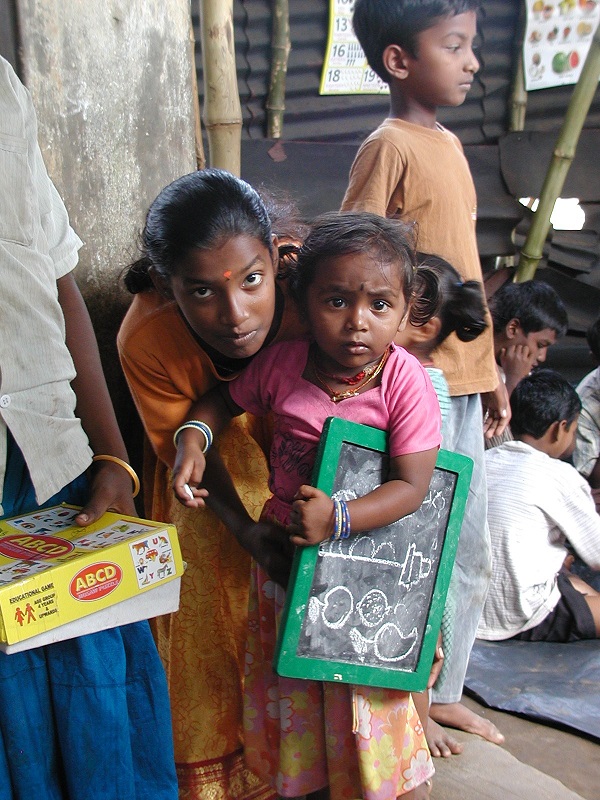 Older children play with younger children at a Child-Friendly Space set up by ChildFund after the most disastrous tsunami on record devastated communities throughout South Asia in 2004.
December 26, 2004, began like any other day for Dilmini and her four children at their home by the sea in Sri Lanka. Dilmini’s husband was at work, her three older children were playing, and she was preparing breakfast for the baby.
When she saw an enormous wave rushing at them from the beach, Dilmini yelled at her older children to run. She clutched her baby and ran too. There was no time to think which way to go – no way to know whether to run to the right or to the left. The three older children ran to the left. Dilmini clutched her baby and ran to the right. It ended up being the wrong choice.
Within minutes, she and her baby were submerged under a wall of water. Dilmini grabbed a rope, fighting to hold on with one hand and hold her baby's hand with the other – but the baby was swept away.
Stories like these are the stuff of nightmares, and yet they were a reality for thousands upon thousands of families like Dilmini’s who survived the Great Indian Ocean Tsunami of 2004. To this day, the tsunami is widely regarded as the worst humanitarian disaster in modern history. Caused by an undersea megathrust earthquake in the Indian Ocean, the tsunami waves devastated communities all along the surrounding coasts, killing nearly 230,000 people in 14 countries. Two decades later, families are still picking up the pieces of their shattered lives.
“I remember being at home in Virginia enjoying the post-holiday slump when breaking news began running across the television screen, blasting that a tsunami had slammed multiple Southeast Asian coasts,” says Cheri Dahl, ChildFund’s Director of Communications. In those days, she was working as the vice president of international fundraising and communications. “It quickly became clear that this was a major multi-country disaster. ChildFund teams were coordinating assistance within minutes.”
ChildFund's emergency response to the great tsunami
Within 24 hours of the tsunami’s arrival, ChildFund staff were on the ground assisting with initial rescue and relief services in our local partner areas. As news of the tsunami swept around the world, ChildFund's international headquarters in Richmond, Virginia, experienced an unprecedented outpouring of support – fielding approximately 200 donor calls an hour and roughly 1,500 online web donations a day.
The flow of resources allowed us to quickly assemble teams of specialists in child protection, health and emergency response who joined forces with local volunteers to amplify relief efforts. By January 5, we had mobilized these staff to provide robust relief to more than 50,000 children and their families throughout India, Indonesia and Sri Lanka.
At the onset, the teams’ support focused on immediate needs – collaborating to help reunite separated families and meet basic needs for food, clean water, shelter and essential hygiene products.
As the response efforts continued, however, and mass burials continued to take place days and weeks after the tsunami, the organization’s attention turned to supporting children’s ongoing emotional and psychological needs – needs that were often not being met in the rush to provide material support.
“Children were walking around listless or sleeping all day. They were not processing what happened to them,” reported Toni Radler, then a ChildFund communications staff member, in an interview on January 5, 2005.
To support child survivors who had been traumatized by their experiences, ChildFund set up Child-Friendly Spaces across the communities where we worked in India, Indonesia and Sri Lanka.
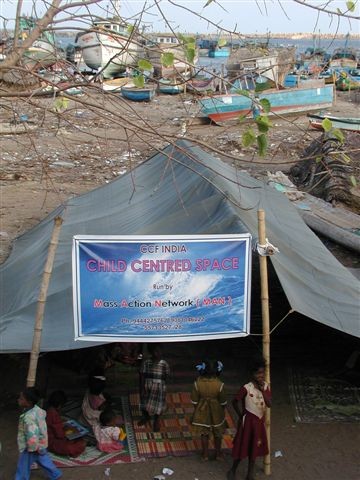 A bird’s-eye view of one of our Child-Friendly Spaces in India, 2005.
Child-Friendly Spaces are exactly what they sound like – safe places, staffed with trained ChildFund and local partner employees and volunteers, where children can come to play, learn and just be children while their caregivers work to rebuild their homes and lives. For children who had lost parents or other family members in the 2004 tsunami, these Child-Friendly Spaces were often their only connection to primary care and safety in the chaotic days immediately following the disaster.
Eventually, they became pathways for children back to a sense of normalcy.
“Through Child-Centered Spaces, informal education, such as math instruction, is being started in the camps. Several of our parent volunteers are actually kindergarten teachers. The children are also playing games and singing songs,” Radler reported. “Schools are planning on reopening in one week. From there, we plan to have the Child-Centered Spaces in the communities.
“It is obvious that the Child-Centered Spaces are making a huge difference for the kids,” she continued. In the months and years that followed, these safe spaces became a key component of a three-year ChildFund tsunami recovery and reconstruction program that helped hundreds of thousands of people rebuild their lives.
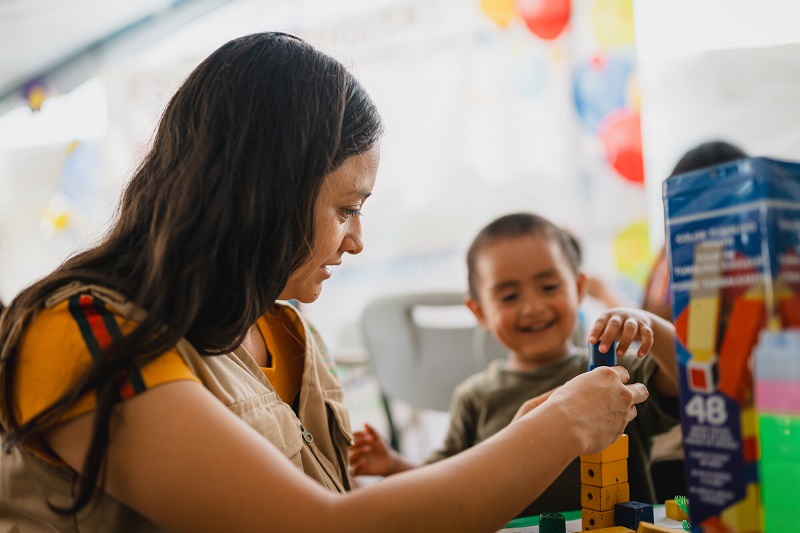 Today, Child-Friendly Spaces are an important part of ChildFund’s work with children in crisis. Here, kids play with ChildFund staff at a modern Child-Friendly Space for migrating families in Honduras.
When children are in crisis, we’ll be there
The learnings from ChildFund’s time supporting the 2004 tsunami relief efforts still fuel our emergency response work today. Child-Friendly Spaces remain the hallmark of our approach to supporting children in the aftermath of a disaster, giving children space to process grief and trauma through play and learning in a safe environment.
“Emergencies amplify risks for children and families on a very large scale,” says Dahl. “There is an urgent need for psychosocial support for children and families and enhanced protections for children. ChildFund is sharply focused on this in emergency situations.”
And, where we still work in India, Indonesia and Sri Lanka, our sponsorship programs continue to provide long-term support to the children, families and communities whose lives were once shattered. The road to recovery has been long and hard, but sustaining support to children and families has helped their communities build resilience over time. That includes disaster risk reduction programs to help children and families learn how to prepare for and mitigate risk during emergencies.
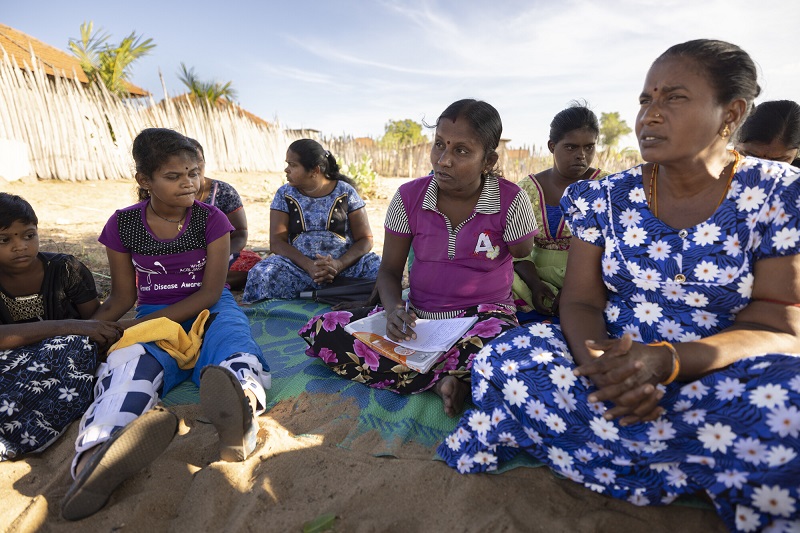 The devastation of the 2004 tsunami continues to impact people today, especially those who were children when it happened. Here, Jeyantha, who lost her arm after being struck by debris from the tsunami at age 12, serves as a bookkeeper in a ChildFund Sri Lanka Self-Help Group for people with disabilities.
Even so, some losses – like that of Dilmini’s little one – can never be fully recovered from.
To support children in crisis when and where they need help most, donate to ChildFund’s Emergency Action Fund today.
Loading...
