Site will be
unavailable for maintenance from June. 4, 11:30 p.m., to June 5, 12:30 a.m. ET. Thank you for your
patience!
Protecting Children and Their Lifelines in Conflict Zones
Posted on 08/26/2025
Even in the darkest times and places, children have the right to safety, the right to a childhood. Grounded in this belief, ChildFund always finds ways to be there for them, to protect them. Even in war, with all its horrors, especially for children.
“It is not a matter of whether we can or should do it,” says Isam Ghanim, ChildFund’s president and CEO. “We have to do it.”
Today, with an unprecedented 473 million children living in war zones — more than the populations of the U.S. and Canada combined — this is no small ask. Children are caught in the crossfire, their schools and access to health care and water and other lifelines shredded. But ChildFund is itself a lifeline, a builder and rebuilder of lifelines, and we are there to help.
ChildFund has long experience responding to emergencies large and small, long-term and short, from typhoons in the Philippines to droughts in the Horn of Africa, to the Sierra Leonean and Ethiopian civil wars, to the refugee crisis in Northern Uganda and more. Our deep, long-term partnerships with local organizations enable us to respond with agility, quickly shifting resources and adapting approaches to meet local needs. But these partners also suffer when large-scale emergencies like war destroy infrastructure and livelihood systems across their communities.
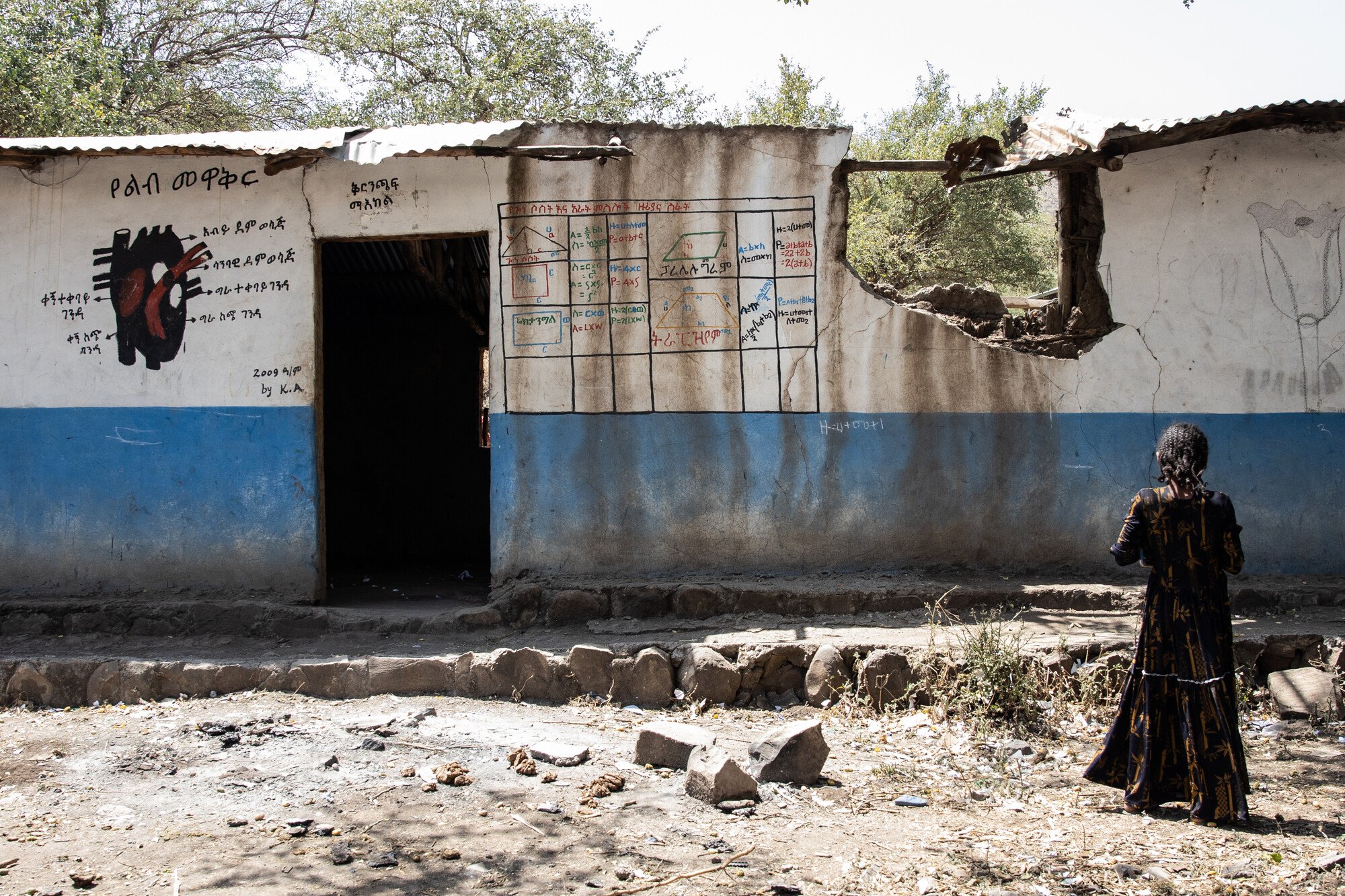
Haimanot, 14, stands outside a bombed classroom. The school was used as a camp for both sides at different times during Ethiopia's two-year civil war and was left in ruins.
“We have to think creatively about the best contributions that we can make,” says Ghanim. “We don’t need all the technical capabilities required to be effective in humanitarian response. What we do need is relationships that will allow us to help and enable others — through financial contributions, technical assistance and policy work — to make sure that these children and their families are protected when there is a humanitarian crisis.”
ChildFund has those relationships, and we are increasingly partnering in exactly this way. To support children affected by conflict, we partner primarily with fellow Alliance member WeWorld, an Italy-based nongovernmental organization with child-focused humanitarian response as a centerpiece of its mission. “Through them and with them,” says Ghanim, “we are able to respond to emergencies in a way that will allow us to not spend time and money developing technical expertise in an area where we don’t have it, and we complement their efforts by bringing our child protection expertise, which is our focus.”
WeWorld, with ChildFund’s support, is currently serving children in conflict zones in Afghanistan, Democratic Republic of the Congo, Palestine and, in partnership with ChildFund Germany, Ukraine.
“Children will remember who comes to their aid,” Ghanim says, “and it is a sword of two blades.” They may recover and do good in their communities … or they may become radicalized. “Resilience means strengthening communities to absorb shocks when they happen, to quickly recover and adapt. If they are supported, they want to do good.”
When communities are supported, Ghanim adds, “they can do miracles.”
Their ability to do so, with all the bright possibilities that follow, depends on all of us.
Loading...
