Site will be
unavailable for maintenance from June. 4, 11:30 p.m., to June 5, 12:30 a.m. ET. Thank you for your
patience!

“I’d rather build something here”: The Power of Livelihoods to Prevent Irregular Migration
Posted on 07/03/2025
“I had seriously considered leaving the country. I thought that to have a future, I had to go somewhere else,” says Uriel.
“When I was in school, we were about 25 or 30 students in class. Now, only four or five of us are still here,” Juli says.
For young people like them in many parts of Mexico and throughout Central America’s Northern Triangle, the prevailing wisdom is that if you want to have a future, you will need to find it somewhere else. And it’s not surprising in view of the generalized lack of opportunity and high poverty faced by young people who are also under-educated, unemployed and under-informed about the dangers of irregular migration. No one really wants to abandon their home, but what other options are there?
Uriel, Juli and others who participated in ChildFund’s Preventing Irregular Migration project in Mexico and Central America have found ways to build lives and livelihoods right where they are.
The multi-year project addressed three major drivers of migration in communities with elevated migration rates: violence, by strengthening child protection services and violence prevention programs at the community level; unemployment, by providing seed funding and connecting young people with the private sector to help them build employment and entrepreneurship skills; and youth engagement, by promoting young people’s engagement with local, national and regional institutions.
By the end of the Preventing Irregular Migration project, 40% of the young people who participated reported being employed.
Information and support to fuel a dream
Growing up, Uriel had always liked the idea of working for himself but didn’t know how to make it happen until he was able to access entrepreneurship and seed capital support through the project. During the pandemic, he took a leap of faith and started baking. “I had nothing, really — I even took sugar from my mom’s kitchen at first, just to get started,” he laughs. “But I knew that if I wanted to make something of myself, I had to try.”
What he learned in the project’s workshops on entrepreneurship, resilience and leadership helped him become part of a community of entrepreneurs that helped him take his business to the next level. His small kitchen experiment is now an established bakery that now supports his family, with his wife, his biggest supporter, managing operations. “With my business growing, I saw that there was a way to build something meaningful right here.”
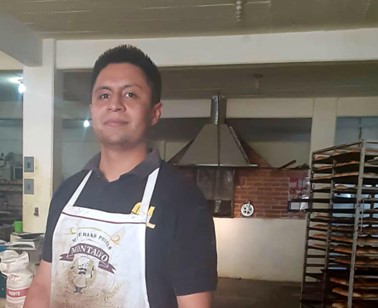
Uriel in his bakery. “With my business growing," he says, "I saw that there was a way to build something meaningful right here.”
The power of mentorship
Alex, another participant, went into the entrepreneurship program unsure of where to begin and initially pitched an idea of 3D-printing protective face shields during the COVID-19 pandemic. But Alex is, at heart, a storyteller interested in filmmaking and technology – not a viable career path, he thought. His mentor through the project, Emilio, helped him see things differently. “He told me, ‘You already have something that makes you stand out – why not build on it?”
Alex changed his business plan, and the project provided him with the seed funding and resources he needed to grow his business. He learned how to price his services, identify potential clients and market himself. The funding helped him buy the equipment he needed to get started.
But it was hard. “The doors were constantly closing,” he says. “Nobody was willing to pay for drone footage at first.” So he began offering free videos to local businesses, and word spread. “I started getting small gigs — weddings, quinceañeras, local events — and little by little, it grew.” And grew, bringing him bigger projects and taking him around Mexico.
As he continues refining his skills, he credits the project for helping him take that first big step. “Without it, I might have never realized I could turn this into a career,” he says.
Learning that endures
Julisa, who goes by Juli, grew up watching most of her peers leave her small town – either to bigger cities or to the U.S. – in search of better opportunities. Wanting to find a way to make things work at home, she joined ChildFund’s entrepreneurship project and received seed funding. She soaked up the workshops on entrepreneurship, market research and business planning.
“They helped us analyze what was missing in our community — what kind of businesses could actually work here,” she explains. With that knowledge, she decided to open a café. “There are plenty of places to eat, but I wanted to create something different — somewhere people could go to sit, have coffee, and just enjoy the space.”
Alas, Juli ended up having to close because the location she had chosen was too far from the town center. Lacking resources to move and start over, she gave in and migrated to the U.S. to work and save money for her future.
But she returned earlier than she’d planned. “It’s easier to make money there,” she says, “but you leave everything behind. I’d rather stay and try to build something here.”
As she considers next steps, she feels more confident in her ability to run a business. “I learned a lot — how to plan better, what to avoid next time. When I start another business, I’ll be more prepared.” This time, she’d like to start a hardware store.
“Animo!”
Children, including those in under-resourced communities, grow up dreaming of what they could become. But in too many places all over the world, as they get older and look at the adults around them — those who haven’t migrated — and see them underemployed or out of work, possibly even struggling with addiction or turning to crime … and as they see the violence around them but no way to do or say anything to change their communities’ difficult realities, of course they look farther afield.
But when youth are offered the opportunity to look both inward and outward at what they might offer in their communities, when they are invited to learn new skills and provided resources to apply those skills, with the support of mentors who help them see new possibilities and weather pitfalls, possibilities expand.
Uriel has a word for others thinking of starting their own businesses: “Ánimo!” (“Don’t give up!”) He adds, “It’s not always easy, but it’s worth it. You don’t have to follow the same path as everyone else — sometimes you just have to start.”
Juli would add, “And start again.”
Learn more about the Preventing Irregular Migration project here.
Loading...
