Site will be
unavailable for maintenance from June. 4, 11:30 p.m., to June 5, 12:30 a.m. ET. Thank you for your
patience!
Nayomi enters the workforce with confidence
Posted on 06/04/2025
Reporting by Jake Lyell, Advisor Sr., Creative Content Producer
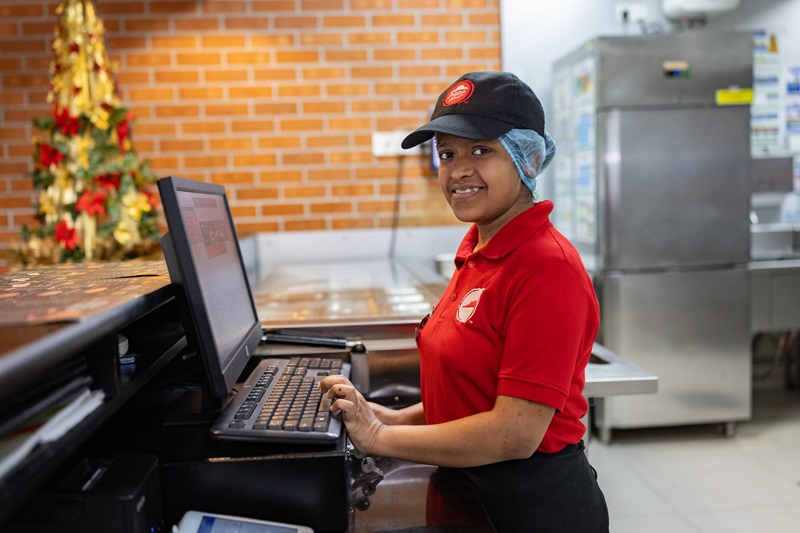 Nayomi, a busy, thriving 26-year-old who lives with Downs Syndrome, works the counter at her job at Pizza Hut in Sri Lanka. In communities like hers, where youth with disabilities often struggle to find gainful employment, steady jobs are hard to come by – but critical for independence and well-being.
“When I was at school, the teachers helped me, but other kids were mean. They would try to make me carry their bags and call me names,” recalls Nayomi of her experience in high school.
Nayomi finished her “O,” or ordinary level* of high school, when she was 19 years old. She is the third and last child of her family. Fortunate enough to grow up in a household where her father had a steady job as a police officer, she didn’t face the severe economic challenges that her classmates and neighbors who relied on agriculture for a living did. But being born with Downs Syndrome and cognitive delays meant that academics were a challenge for Nayomi. She had trouble concentrating and had to repeat two grades when she was younger.
“I had two friends [in high school], but everyone else was mean to me,” she recalls. “My plan was just to study hard and be a good person.”
After failing her “O”-level exams on the first try, she passed and was able to graduate on her second attempt.
Entering secondary education or the workforce after graduation was not feasible for Nayomi, however. Paying jobs are hard to come by in Sri Lanka, whether for skilled or unskilled labor. Vocational training for youth with disabilities was even publicly offered through Sri Lankan Social Services throughout the country, but very few youth attended these courses because the program lacked organization and proper equipment, and the skills taught there were generally not marketable. In fact, four years ago, only about 5% of youth with disabilities who entered Sri Lanka’s government vocational training program went on to obtain gainful employment, according to research conducted by ChildFund in conjunction with Kelaniya University. This was just one of the problems ChildFund sought to address with its Community-Based Inclusive Development (CBID) program for children and families with disabilities in Sri Lanka.
Because of the gaps that existed in vocational training programs for children with disabilities like Nayomi, she spent four years waiting at home after finishing high school. She occupied her time by helping her mother out with housework, cooking and working in the family’s garden.
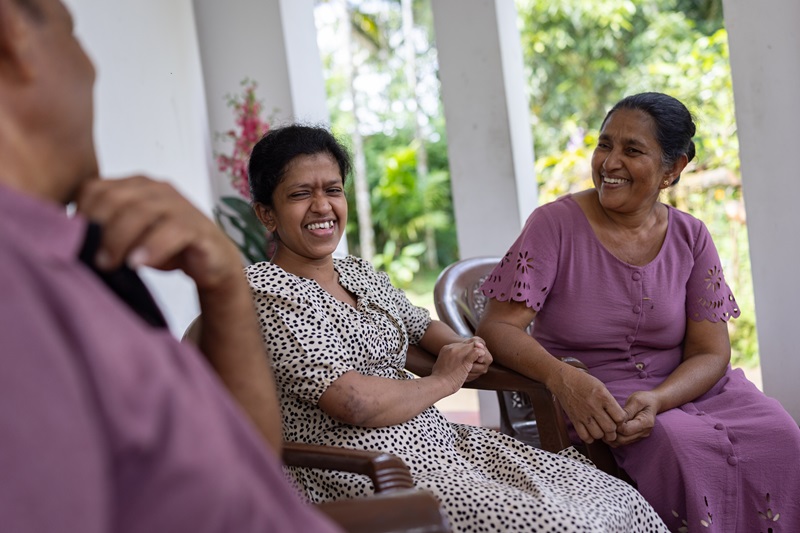 Nayomi with her mom and dad at home.
One day, however, a staff member from ChildFund stopped by the house to talk to the family about an exciting development: ChildFund would be supporting Sri Lanka’s vocational training institutes, including one near Nayomi’s house, with five new training courses – mobile phone repair, graphic design, food technology, plumbing and retail sales. Nayomi would need to apply soon if she wanted to join.
“When I joined the department, I saw that there's a huge gap with the vocational training,” says Darshani Karunarathna, Director of Social Services for Sri Lanka, who began her role soon after ChildFund’s CBID program was getting started. “This project aims to fill that gap with the support of ChildFund. They performed research focusing on the productivity of our vocational training centers. According to that research, they gave us recommendations for more market-oriented vocational training programs. And according to those recommendations, we have now introduced five new vocational training courses with the help of ChildFund. So now I think we are on track to improve our vocational training centers.”
“I started to cry at first because I felt so happy,” says Nayomi, who was also a bit nervous at the prospect of learning a trade. But after being accepted, Nayomi decided she wanted to learn food technology, a course which teaches commercial cooking and baking skills.
“It was totally different,” says Nayomi, comparing her vocational training experience to that of her high school career. “At the VT center, everyone was helpful, and I made really good friends.”
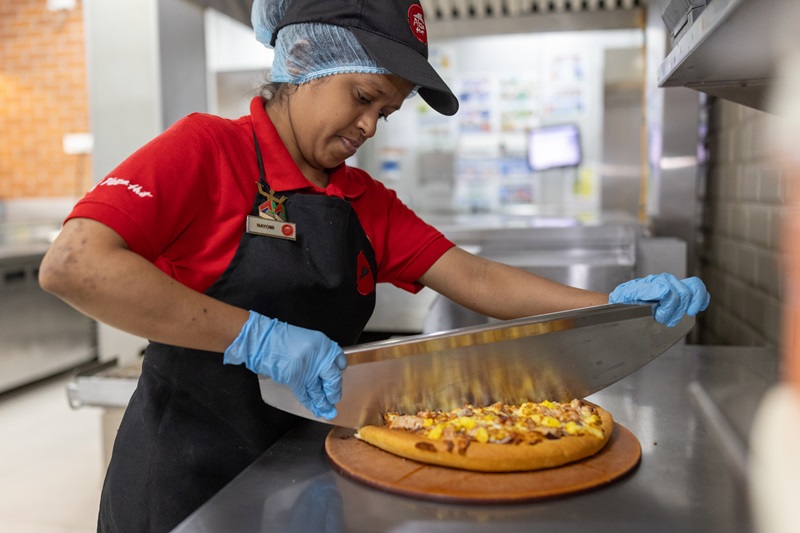
ChildFund Sri Lanka, leveraging its connections with its generous corporate partner Pizza Hut Sri Lanka, also worked to forge a special track where youth in the food technology course could learn specialized skills in preparation for work in one of Pizza Hut’s many restaurants across the country. Both Nayomi and her best friend, Tikeri, whom she met at the center, followed this track, learning how to cashier, prep and bake food at the famous pizza chain, albeit a little differently than they do in the U.S. Nayomi’s favorite type of pizza is the Spicy Chicken Tikka.
The changes that ChildFund helped usher into Sri Lanka’s vocational training system were not just a result of research and recommendations. The organization also developed new national curricula for each of the new vocational streams, trained the teachers providing the new instruction, and outfitted centers with new equipment like computers, cooking equipment and supplies and electrical equipment. At one school, ChildFund rehabilitated the dormitory so students could have a suitable place to stay. At others, ChildFund is paying wages for teachers of the new vocational streams until the government is able to fully absorb their costs.
“With the support of ChildFund, we have formed a five-year strategic plan for our department,” says Director Darshani. “We mainly focused on empowering those persons with disabilities, especially youth with disabilities, and modernizing our vocational training centers. If we link together, we can perform these social services better.
“ChildFund helped us to offer these new courses, and now we are in the process of recruiting new youth with disabilities for next year's enrollment. By introducing these techniques, we can increase our [students’] employability.”
Today, more and more youth with disabilities like Nayomi are learning marketable skills and going on to obtain gainful employment after their training.
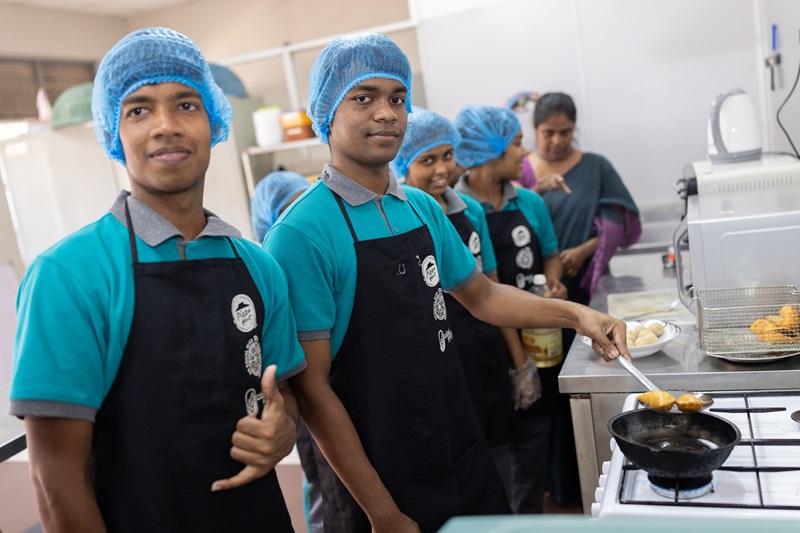 Youth attend the Food Technology course at the vocational training institute.
“I have a job now, and I can help others. I donate to the temple and help my parents out,” says Nayomi, who today – along with her best friend – works 43 hours a week at a Pizza Hut about 12 miles away from her home.
“I want to keep learning and improve myself,” she says. “I want to stay with Pizza Hut but maybe be a manager one day. Managers have to learn everything, though.”
*Under the British system of education, adopted by many of its former colonies, students graduate high school with an Ordinary, or “O”-level diploma after completing a basic level of education, usually around the age of 16. Students that wish to go on to university one day must first earn an Advanced, or “A”-level high school diploma, by studying an additional two years in high school before passing examinations.
Loading...
