Site will be
unavailable for maintenance from June. 4, 11:30 p.m., to June 5, 12:30 a.m. ET. Thank you for your
patience!
Defying stereotypes: Male leaders champion girls’ education in Sierra Leone
By Mohamed Conteh, Communications Officer, ChildFund Sierra Leone Posted on 10/09/2025
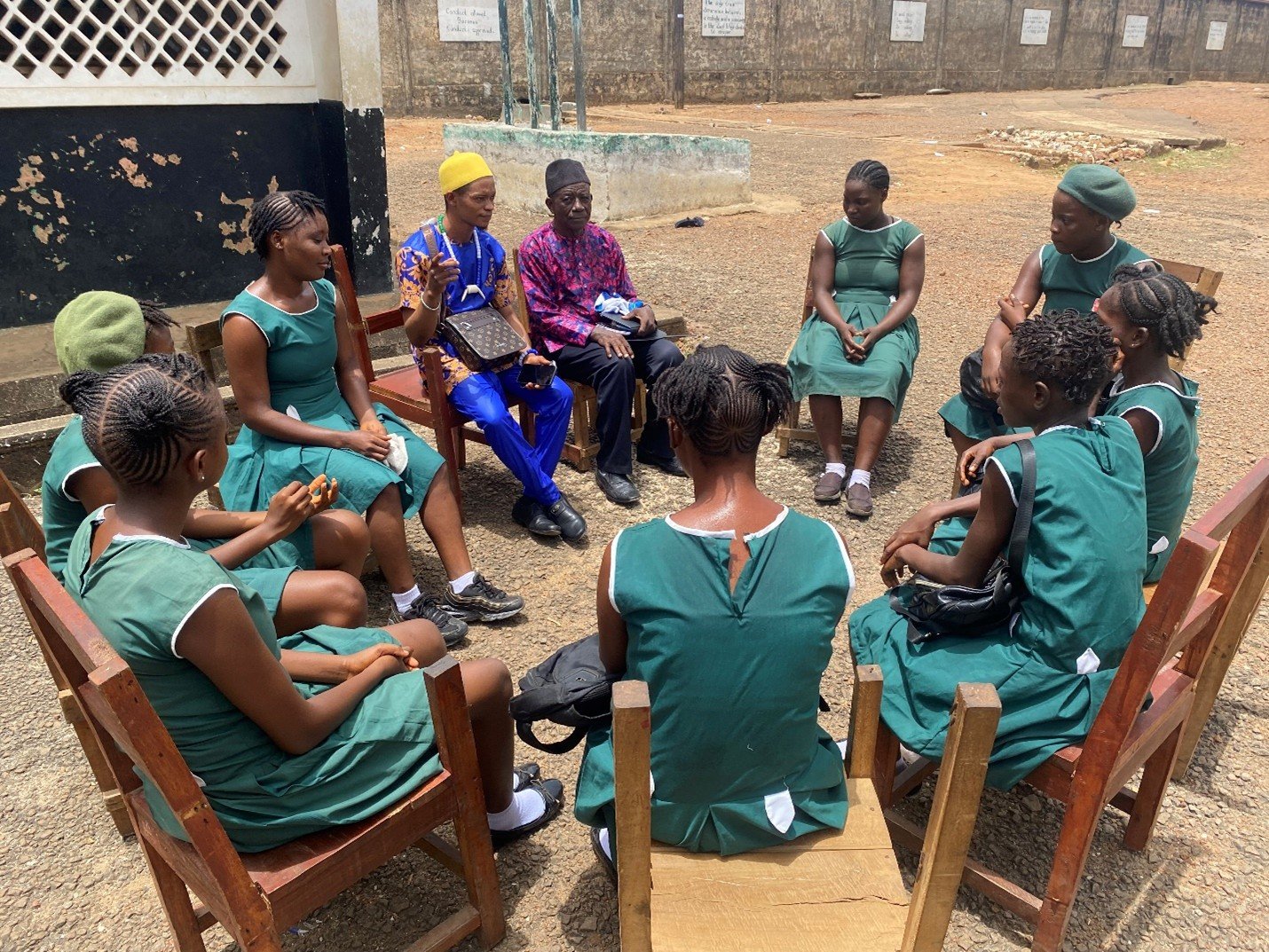 Girls in Sierra Leone attend a meeting with tribal chiefs Pa Alimamy and Mohamed Bangura, who are leading the efforts to increase girls’ school enrollment in their communities.
In many rural communities in Sierra Leone, a small country on the coast of West Africa, most people believe that a girl’s place should be in the home, while only boys should go to school. These gender stereotypes keep many girls out of school each year – especially teenage brides and mothers, who are expected to drop out after becoming pregnant.
Often, the people most apt to safeguard these traditional beliefs are male community leaders, known locally as tribal chiefs. Historically acting as custodians of culture, tribal chiefs are expected to conserve traditional practices and beliefs, including those that do not always take girls’ experiences and issues into account. That’s why these leaders have traditionally been reluctant to seek solutions to the many problems girls face, such as female genital mutilation or cutting (FGM/C), child marriage and subsequently dropping out of school.
Now, some tribal chiefs are working to change that narrative.
Meet Chief Pa Alimamy Sesay II and Chief Mohamed Bangura, two respected tribal heads living in the Juba community on the outskirts of Sierra Leone’s capital, Freetown.
The two men have known each other for years, but they became especially close after getting involved with the Increasing Access to Secondary Education for Out-of-school Girls Project, a joint project of ChildFund and the Korea International Cooperation Agency (KOICA). So far, the project has been successful in re-enrolling 120 girls to six schools in the western rural and urban Districts of Sierra Leone.
Understanding the obstacles to girls’ education in Sierra Leone
Girls in Sierra Leone have been through a lot in recent years. A brutal civil war from 1991-2002 brought an increase in violence against women and girls. Then there was the Ebola crisis of 2014-2016, which led to widespread school closures and an increase in early marriages and teen pregnancies. When schools reopened, the government banned visibly pregnant girls from attending mainstream schools, a policy that was changed only recently.
On April 8, 2021, the Sierra Leone Cabinet approved the National Policy on Radical Inclusion in Schools, which seeks to ensure that schools throughout Sierra Leone are accessible to, and inclusive of, all children – especially those groups that are historically marginalized or excluded from formal schooling, like pregnant girls. But there is still much work to be done before girls can fully realize their right to an education.
Chief Pa Alimamy and Chief Mohamed saw the struggles that girls in their community were facing and wanted to be a part of these steps in the right direction.
They decided to join ChildFund’s Male Action Group in their area. The group consists of male leaders in the community who come together to help raise awareness about the importance of girls’ education – holding community meetings, even going door-to-door to work with families and help girls stay in school.
Today, the two chiefs have successfully assisted in re-enrolling more than 25 girls in their communities who were out of school. It wasn’t an easy endeavor.
“We faced so many challenges during the first year of the project, like reluctance from some parents in re-enrolling their girls to school,” says Chief Pa Alimamy. “Using our authority as tribal heads, we were able to convince them. Some of the parents and guardians frowned at re-enrolling the adolescent mothers, but they accepted after we invited them to several meetings.’’
One of these young moms was Millicent (not her real name), who dropped out after becoming pregnant at age 15. Now 16, Millicent is happy to be back in school after the project pledged support for her fees and learning materials, as well as childcare while she is in class.
“I’m so grateful that Chief (Pa Alimamy) was able to identify me for this project because I really needed it,” she says. “I was quite unhappy when I left school because I felt that my dream of becoming a nurse would not be achieved if I were a dropout.”
Aside from raising awareness about the importance of girls’ education, the chiefs have also imposed fines on families that do not send their girls to school.
“What we did at our community is to establish by-laws that will force parents or guardians to send their children to schools,” says Chief Mohamed. “We now place a fine of Le 500 ($22 USD) on any parent that refuses to send their child to school.”
Next steps for girls’ education in Sierra Leone
Beyond promoting girls’ education, local leadership is working to tackle the child protection issues that prevent girls from completing school – like FGM/C and child marriage.
In January 2024, social media was inundated by news of three girls who died while undergoing FGM/C in Kambia District, northern Sierra Leone. Ineffective or contradicting laws often contribute to these tragic instances of violence against girls. While the Child Rights Act (CRA) of 2021 states that the official age of consent in Sierra Leone is 18, the Customary Marriage Act (CMA) states that the legal age of marriage is 16. This huge discrepancy, coupled with other child rights issues, is why ChildFund Sierra Leone and like-minded organizations are pushing for the CRA’s review and passage into law.
People often downplay the role of men in girls’ education and protection, but as tribal heads like chiefs Pa Alimamy and Mohamed Bangura have shown, men in power play a critical part in ensuring that girls can stay safe, get an education and achieve the life of their dreams. Their courage is a call to action for other communities, systems and structures to follow suit.
Loading...
