Children and youth restore mangrove forests one seedling at a time
Posted On 06/03/2026 | 2 minutes
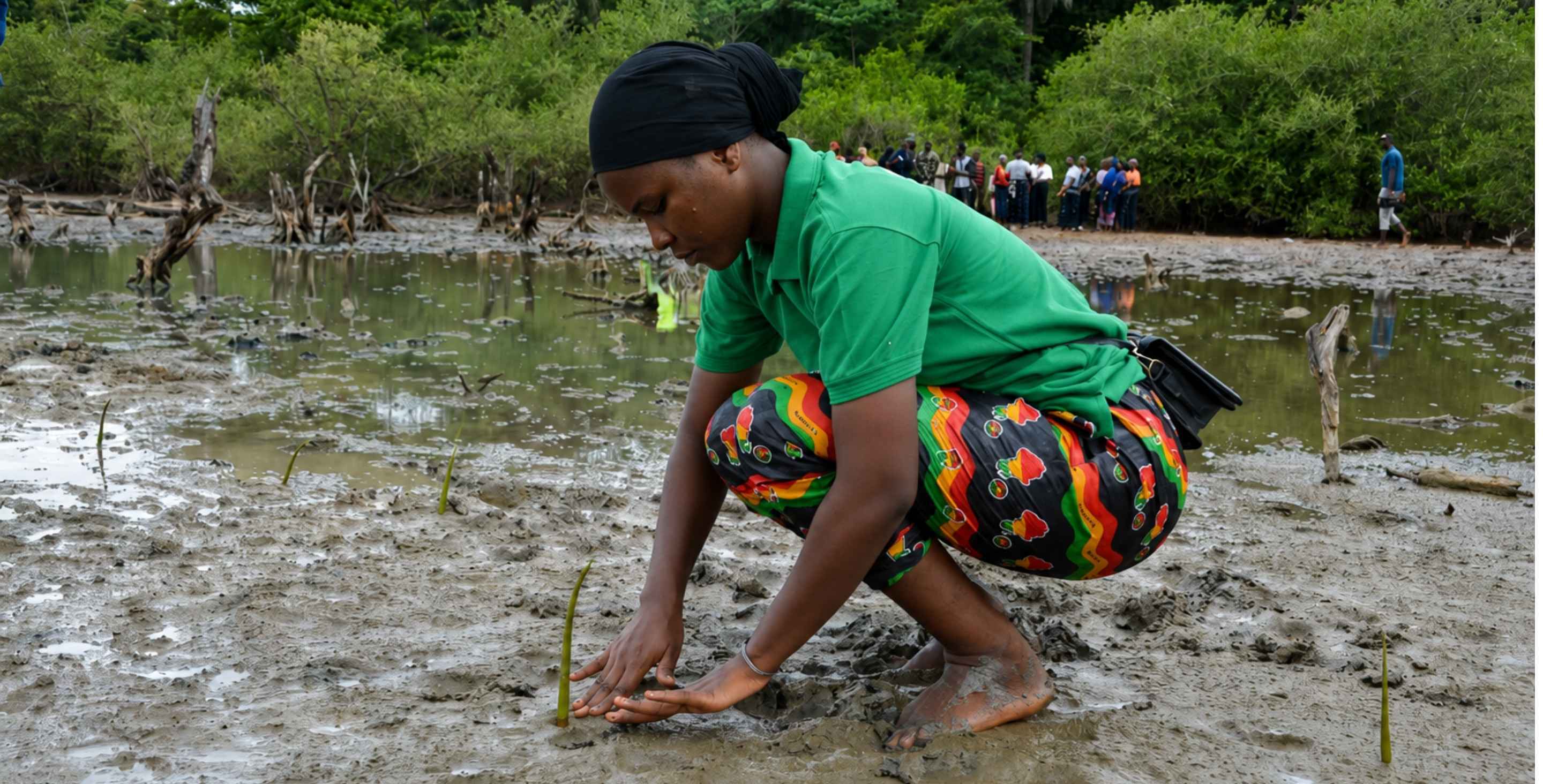
“When we protect our mangroves, we protect our food, our homes and our future,” says 19-year-old Fatouma, who lives in Senegal’s coastal Ziguinchor region.
In her community, the degradation of the natural environment and its resources feels immediate—and personal. And nowhere is it more visible than in the mangrove forests, a crucial natural defense that protects coastlines from erosion, stores carbon and provides critical ecosystems for marine life.
In recent years, unsustainable aquaculture, infrastructure development, pollution, and climate stressors such as sea-level rise and salinity intrusion have caused these ecosystems to lose their ability to effectively buffer coastal communities and sustain livelihoods. Yet when mangroves return, so does food security—and resilience.
For Fatouma and her community, environmental restoration is no longer an abstract goal: It is being led by young people like her who are reclaiming their future. Through the Youth in Action Against Environmental Degradation project in which Fatouma participates, youth leaders, in partnership with ChildFund and local governments, have planted over 10,000 mangrove seedlings across four hectares in just two years. Already, fish stocks have improved, and the soil is more fertile.
ChildFund’s initiatives place a strong emphasis on child and youth engagement that is age-appropriate, voluntary and safe. Young people actively contribute to site selections, nursery management, mangrove planting and monitoring, while also leading advocacy campaigns on coastal conservation and environmental awareness. In doing so, the participants build skills, confidence and environmental stewardship.
A few hours north in The Gambia, along the riverbanks of Kalagi, mangrove ecosystems are equally important for livelihoods, food security and community life. For generations, families have depended on thriving mangroves for fishing and oyster harvesting. Yet as these ecosystems degrade, the impacts extend beyond the environment, reshaping daily life in ways that affect children most—limiting time for education and increasing household vulnerability.
ChildFund is working with communities here to reverse this trend. In Kalagi and across the Foni districts, earlier restoration efforts (from 2012–2013) helped rehabilitate 2–3 hectares of degraded mangrove forest, planting approximately 10,000 seedlings to restore fish and oyster habitats and protect river ecosystems. More recently, community-led initiatives supported by ChildFund and our local partners have scaled these efforts, with 17,200 mangrove seedlings planted and a remarkable 90% survival rate. Restoration activities prioritize native species that have been identified in collaboration with the Ministry of Environment, ensuring ecological suitability and long-term resilience.
Sometimes the restoration efforts point to the need for a more comprehensive approach that supports children’s holistic needs. In the small village of Jalikassa along the River Gambia, for instance, mangroves have historically sustained the community’s primary fishing economy. But when fish stocks declined, families were forced to spend longer hours on the river, and children were often kept out of school to help make ends meet.
ChildFund supported the construction of an early childhood development (ECD) center here so that young children could have a safe place to learn and play while their parents work. This integrated model addresses immediate needs while also laying the foundation for long-term systems change—where healthier ecosystems reduce pressure on households and enable children to stay in school. Such an approach goes beyond environmental restoration and focuses more comprehensively on restoring time for learning, strengthening food security and creating a safer, more stable future for children.Meanwhile, in Asia, mangrove forests in Sri Lanka’s coastal districts of Jaffna and Batticaloa have experienced similar degradation in recent decades. The loss of natural coastal barriers leaves children, families and communities more exposed to flooding and storm surges, while declining fish stocks threaten household income, food security and nutrition. These pressures can disrupt children’s education, increase health risks and exacerbate stress within families already facing challenges.
The Mangrove Guardian initiative, implemented by ChildFund Sri Lanka with local partners and funded by Barnfonden, responds to these interconnected risks by restoring mangrove ecosystems through a nature-based, youth-led approach. The project includes planting native mangrove species along with hydrological restoration—which helps to improve water quality and re-establish natural tidal flows and sediment processes. The pilot initiative spans two hectares and directly reaches an estimated 1,200–1,500 people, including hundreds of children, youth and women engaged in restoration and stewardship activities. Early outcomes of the pilot show increased environmental awareness and community ownership, laying a foundation for sustained ecosystem management with intergenerational support.
Young people are not only restoring ecosystems, but they are also reviving lifelines for their communities—especially for women, who can once again reap the income benefits of harvesting oysters, which thrive in mangrove-dense areas. And there is ample opportunity and desire to scale these programs. In Senegal, for instance, plans are in place to expand efforts to at least five additional hectares of degraded mangroves, restoring 60,000 more trees.
In a world facing accelerating environmental impacts, young leaders like Fatouma remind us that restoration is not only about healing ecosystems—it is about trusting youth to lead the way forward.
“We can already see the difference,” says Fatouma. “The fish are returning, and we are more hopeful for what’s to come.”
Through our sustainability programs, ChildFund is contributing to the global momentum of the UN Decade on Ecosystem Restoration—a worldwide effort to prevent, halt and reverse the degradation of ecosystems.